Spent two hours building a detailed MSP proposal. Scope of work, SLA tiers, pricing breakdowns, compliance frameworks, onboarding timelines every section accounted for. You hit send.
Then Silence.
Three days later, a one-line reply: “We went with another vendor.”
It wasn’t your pricing. It wasn’t your service offering. It was your proposal that the client never actually read it.
This is quite a deal killer that MSPs rarely talk about: proposals that are technically comprehensive but practically unreadable. They bury the value, exhaust the reader and hand faster-moving competitors a win they didn’t earn.
If your close rates are lower than they should be, your proposal structure might be the problem, not your pitch.
The Long Proposal Illusion
Most MSPs equate length with credibility. The logic makes sense on paper: a 20-page proposal signals thoroughness, expertise and seriousness. It shows you’ve done your homework. It justifies your pricing.
But here’s what’s actually happening on the client’s side.
Your contact list is likely office managers, CFO or business owners with no IT backgrounds, opens a dense document and scans for two things: What will this cost me, and what do I actually get ? When those answers are buried on page 11 between the risk matrix and a hardware inventory table, they give up.
They don’t tell you they gave up. They just ghost you or go with whoever sent them something simpler.
Longer proposals don’t build trust. Clarity builds trust. Length is just noise.
What “Proposal Chaos” Actually Looks Like
If any of these sound familiar, your proposal structure is costing you deals.
No Clear Hierarchy
Clients can’t distinguish between what’s critical (your service tier, your pricing, your response SLAs) and what background context (your company history, vendor partnerships, technical methodology). Everything is weighted the same, so nothing stands out.
Walls of text with no visual relief.
When every section looks identical, the eye has nowhere to rest. Clients skip ahead or stop reading entirely.
Buried Pricing
Putting the investment section at the back of the document forces clients to wade through everything else before reaching the number they care about most. By the time they get there, they‘ve lost patience.
No Logic Flow
A winning proposal tells a story: here’s the problem, here’s what we’ll do about it, here’s what it costs, here’s what happens next. When sections are out of order or disconnected , that story breaks down and clients feel confused rather than confident.
Internal Confusion Mirrors Client Confusion
When your own team struggles to find the right section, update a price, or verify what was promised that chaos eventually surfaces in client conversations as inconsistency or error.
The irony is that the proposals designed to show off your capabilities end up undermining them.
The Anatomy of a Proposal Clients Actually Read
A high converting MSP proposal isn’t necessarily shooter, it’s structured. Every section earns its place, and clients can navigate to what matters without reading everything in sequence.
Here’s what it looks like in practice:
- Executive summary (lead with outcome)
This is the section most MSPs either skip or bury at the end. It should be the first thing a client reads. One page. Three components: what problem you’re solving, how you’ll solve it, and what the client's business looks like on the other side of engagement with you. Write it for a non-technical decision-maker who may forward it to someone who ever sees the rest of the document.
- Clear Navigation
A table of contents isn't just a formatting nicely, it’s a trust signal. It tells the client the document is organized, that you respect their time and they’re in control of what they read first. Clickable or linked sections are even better, especially for longer proposals delivered digitally.
- Scope Services (specific, not exhaustive)
Describe what you’re delivering in plain language. Use clean sections, one per service line or workstream. Avoid stacking every technical specification into this section; save granular detail for an appendix or a separate statement of work if needed.
The goal here is for a client to read this section and think: I understand exactly what I'm buying.
- Pricing (Visible, not hidden)
Present your investment options clearly and early enough that clients can reference them while reading the rest of the proposal. If you offer tiered packages, lay them out side by side so comparison is easy. Don’t make clients hunt for the number.
- Why You (Short and confident)
A brief section, not a full company history that answers why your MSP specifically is the right fit for this client. Case Studies, relevant verticals or specific credentials. This is where social proof lives. Keep it right.
- Next Steps (one clear action)
End with a single, specific call to action. Not “feel free to reach out with questions” that puts the burden on the client. Instead: “To Move forward, sign below and we’ll schedule your onboarding kickoff within 48 hours.” Make approving the proposal the path of least resistance.
Why MSPs Keep Sending Proposals That Don’t Work
It’s not laziness, it’s the tools.
When MSPs build proposals in Word, PDS editors or generic document platforms, there’s no structure built in. Every proposal starts from scratch. Sections get added based on whatever the previous proposal had. Formatting is inconsistent. Nothing is templatized. The result is a document that reflects internal processes, not client experience.
The other problem is that without proposal-specific tooling, MSPs can’t see what happened after they hit send. Does the client open it? How long do they spend on it? Which sections do they skip? That data doesn’t exist, so there’s no feedback loop, MSPs keep sending the same structure and blaming the market for their close rates.
How Zometum Fixes This
Zomentum is built specifically for MSP quoting and proposals which mean the structure, navigation and presentation problems above are handled at the platform level, not patched together manually.
Auto Table of Contents
Every proposal automatically generates a navigable table of contents. Clients can jump directly to pricing, services or next steps without scrolling through sections they don’t need. That simple feature changes how a proposal feels from a wall of content to a document designed with their time in mind.

Clean, consistent sections
Zomentum’s proposal template enforces a logical hierarchy so every proposal your team sends follows the same professional structure. No more ad hoc formatting. No more wondering if a section was included. Your junior reps build proposals that look and read like they came from your best closer.
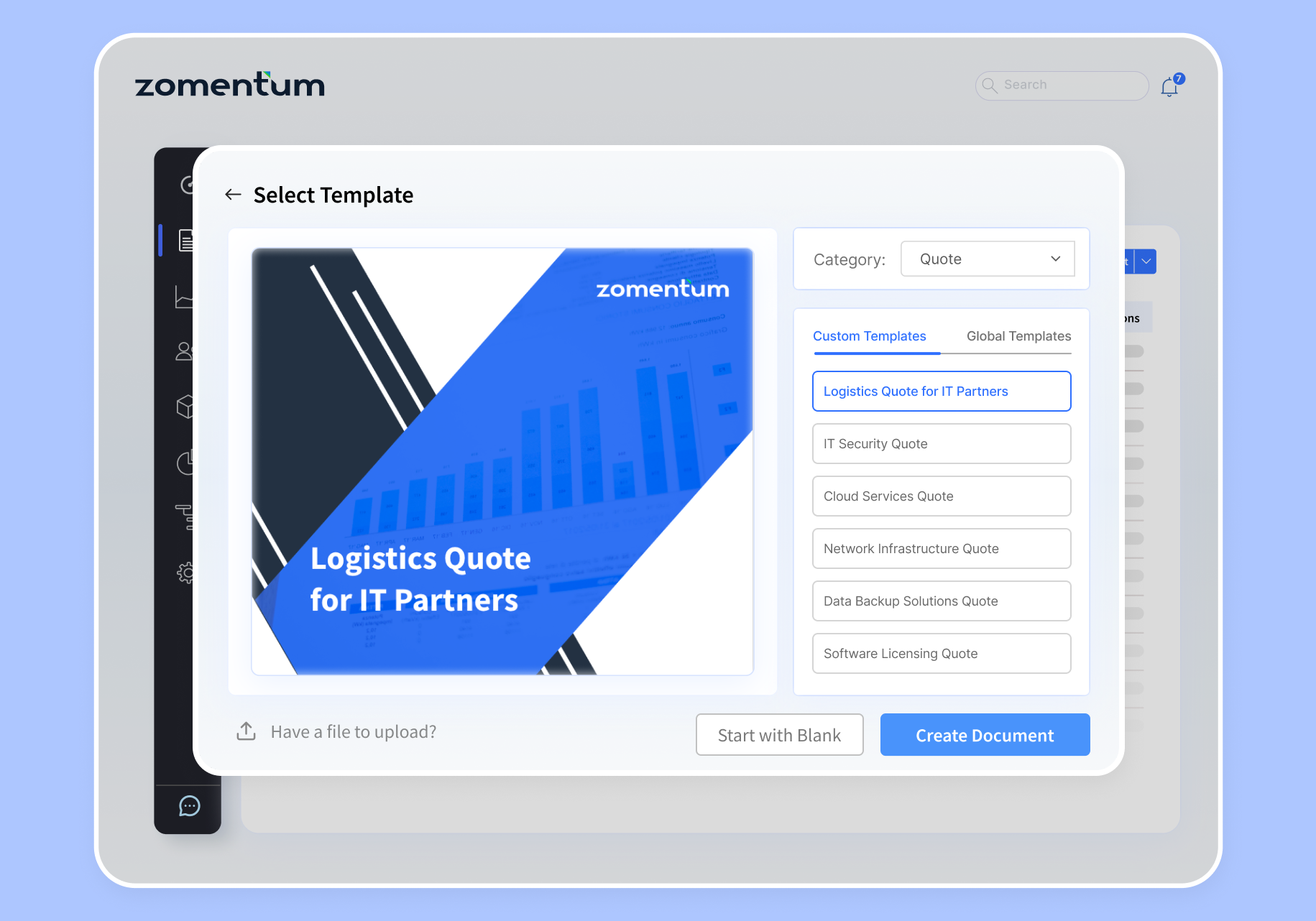
Rich Link Previews.
When you reference vendor documentation, product pages or supporting resources, Zomentum renders those as rich previews inside the proposal, not bare URLs that pull clients out of the reading experience.
Faster Internal Alignment
Because proposals are built on a shared platform with consistent structure, your internal team can review, update and approve drafts without confusion. Everyone’s working from the same document, not tracking down the latest version in someone’s email.

Proposal Analytics
Know when your proposal was opened, how long a client spent on it, and which section they engaged with. That visibility closes the feedback loop and lets you follow up at exactly the right moment.
The result isn’t just better looking proposals. It’s a measurable improvement in how quickly clients understand your value, make decisions and sign.
Clarity Is Your Competitive Advantage
When two MSPs are competing for the same account and one sends a 24-page PDF with no navigation and buried pricing and the other sends a clean, structured proposal with a clear table of contents, readable service descriptions and a visible investment summary, the second MSP wins. Not because their services are better. Because their proposal was easier to say yes to.
Your proposal is often the last thing a prospect sees before making a decision. It should make that decision feel easy.
Stop sending proposals clients have to work to understand. Start sending proposals that do the work for them.
See how Zomentum structures proposals that close faster.
.png)