


If you run an MSP, getting paid on time isn’t just a cash flow issue, it’s a business model issue. Every day a client invoice sits unpaid is cash you can’t use to pay technicians, renew tools or invest in the growth. Payment automation has become a baseline expectation for MSPs that want to run lean and two platforms come up constantly in those conversations: Zomentum Payments and ConnectBooster.
Both promise to eliminate manual follow up, automate collections, and integrate with your accounting stack. But how they deliver on those promises and what they cost you in the process, tells a very different story.
This post breaks down what MSPs need to know before committing to either platform.
Why MSP Payment Automation Is Different
Generic Payment tools are built for B2C e-commerce or professional services. MSPs have a fundamentally different billing reality: recurring monthly contracts, multi-tiered service agreements, mixed invoice types (managed service vs project work vs hardware), and clients who pay anywhere from $500 to $50,000 a month.
That complexity demands more than a payment gateway with a nice interface. It demands a platform that understands MSP billing structures, one where Autopay rules can be set at the customer level, invoices can be collected partially when appropriate and accounting reconciliation doesn’t require a part-time bookkeeper to untangle.
When you evaluate ConnectBooster and Zomentum Payments through that lens, the differences become significant quickly.
Feature Comparison: What Actually Matters
Payment Collection & Automation
Both platforms support Autopay at the client level, allowing you to set collection rules tied to your recurring contracts. Both store payment credentials securely via PCI- compliant tokenization, and both offer automated dunning, the sequence of reminders that go out when a payment doesn't land on time.
Where they diverge is in the finer details.
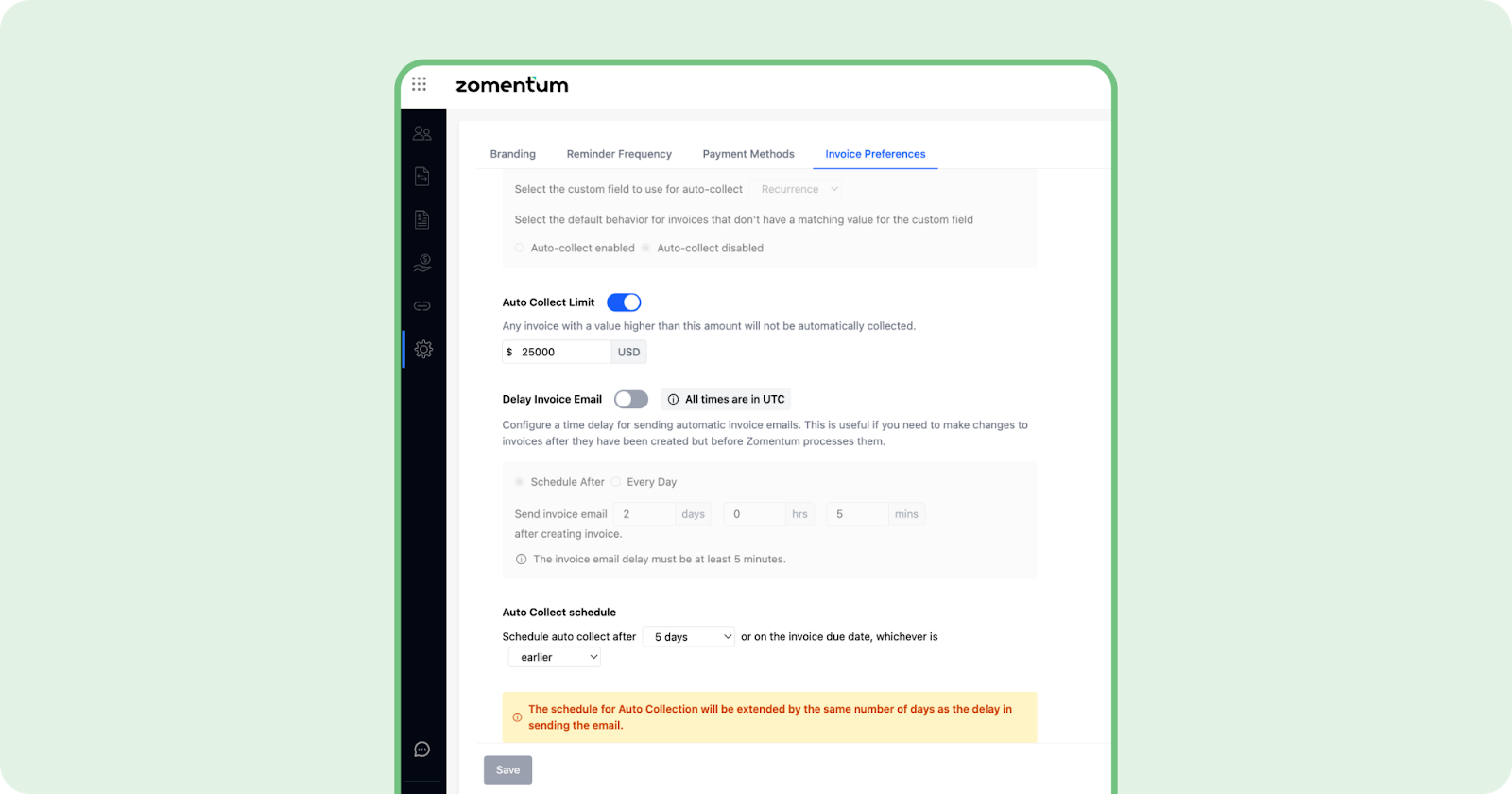
Partial Payments
Zomentum Payments is introducing (Q2 2026), and ConnectBooster doesn't offer them at all. For MSPs managing clients on installment agreements or handling disputes on specific line items, this matters. Not every unpaid invoice should be all-or-nothing.
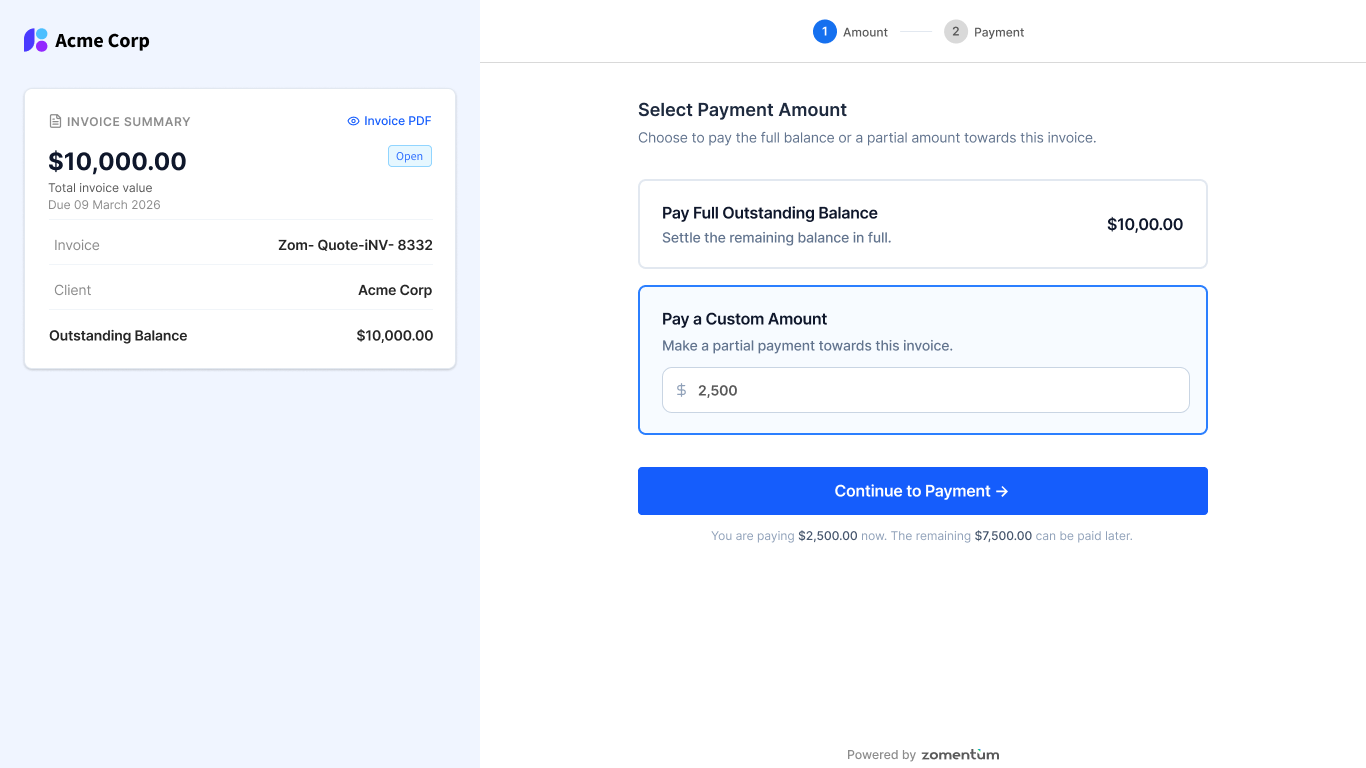
Custom Field Based Collection Rules
Zomentum Payments fully supports autopay by a set number of days based on the invoice type or client tier.
ConnectBooster rules engine is tied to agreement type in the CRM, but custom schedule delays at the field level aren’t confirmed.
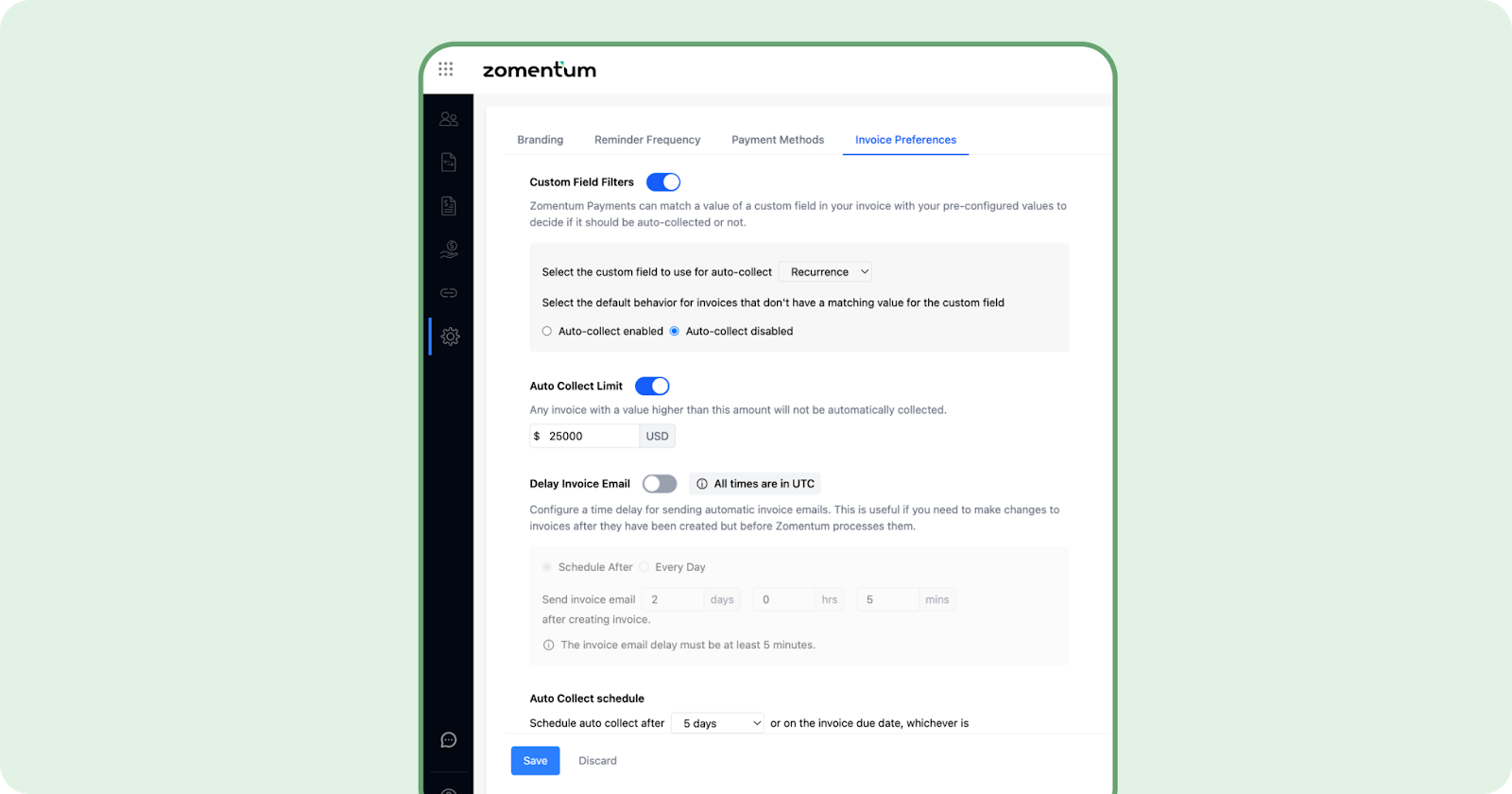
Chargeback Management
Zomentum Payment handles automated chargebacks and refund reconciliation natively.
With ConnectBooster, chargeback management is handled by the underlying gateway processor, not by ConnectBooster itself meaning you’re dealing with a third party when a dispute arises, not your payment platform.
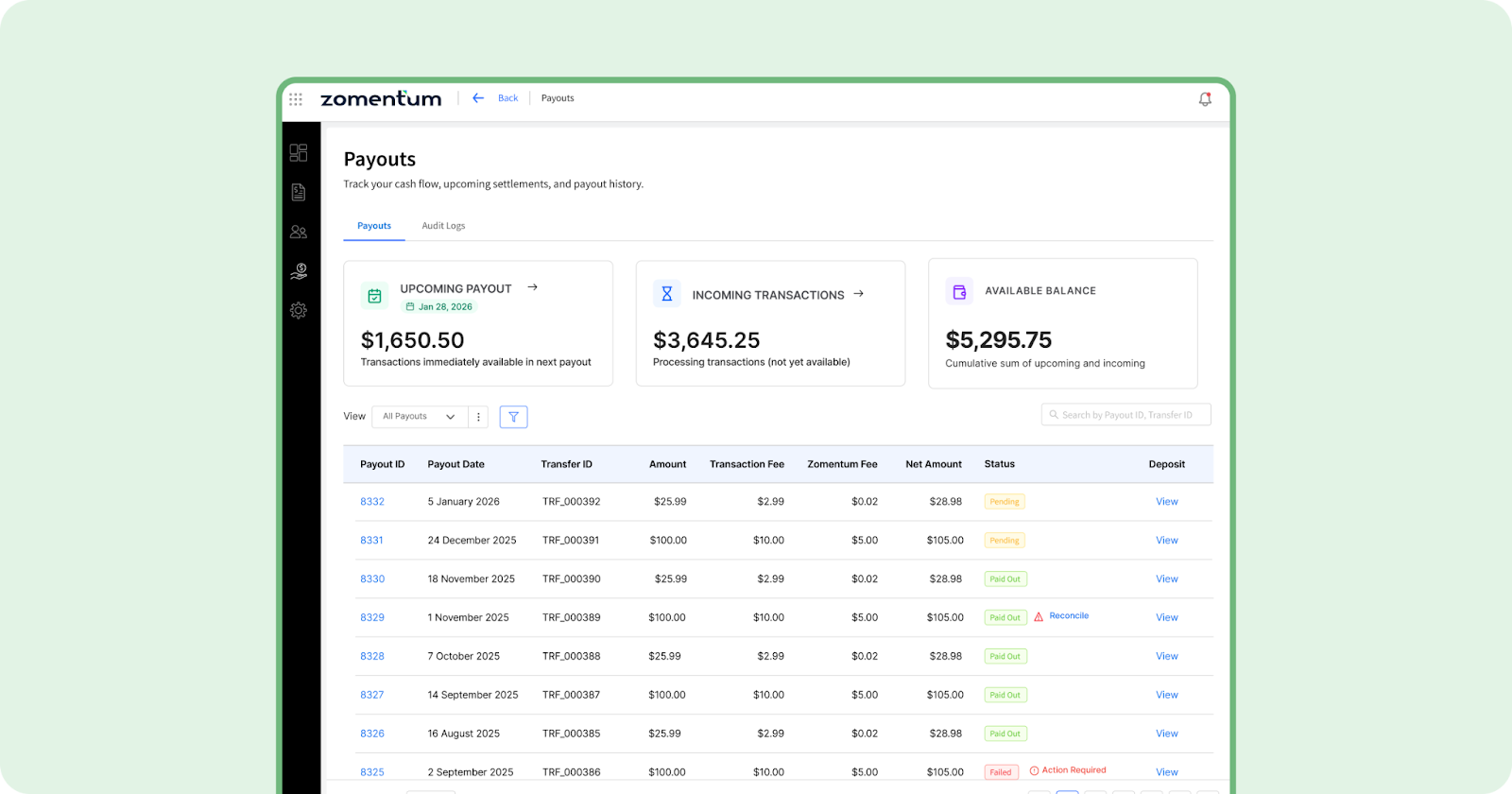
Accounting Integrations
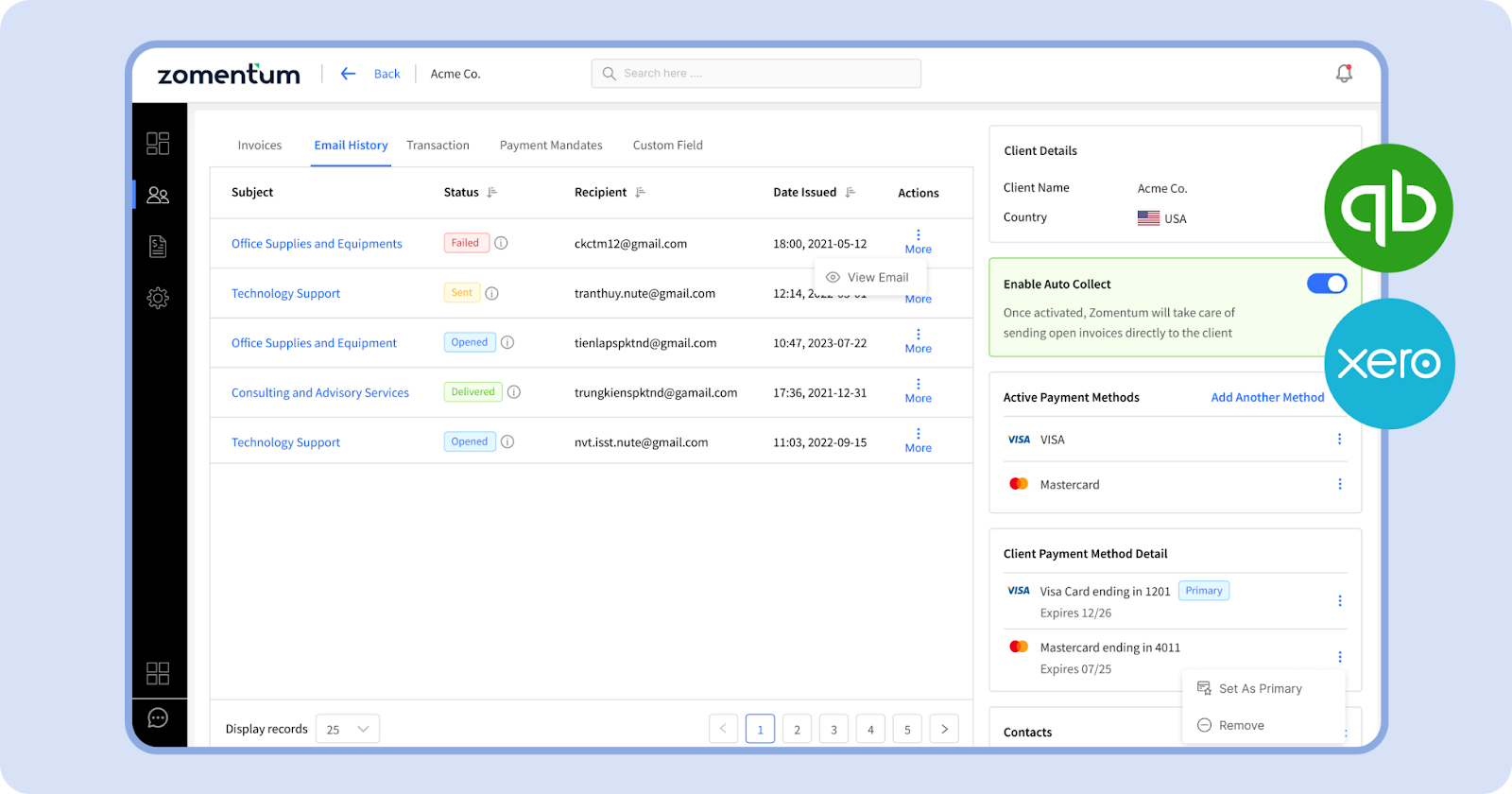
Both platforms integrate with QuickBooks Online and Xero, which cover the vast majority of MSPs.
Zomentum Payments also explicitly supports QuickBooks Online UK, which ConnectBooster lists as a general QuickNooks Integration without distinguishing the UK version.
Payout Speed
This is a meaningful operational difference.
Zomentum Payments offers T+1 payout (next working day).
Connect Booster’s payout timing is controlled by its gateway processors Clearent, BNG Payments, Payliance or ACHQ and NO T+1 SLA is documented.
For MSPs managing tight payroll or vendor payment cycles, the gay between “payment processed” and “cash in your account” adds up fast.
Pricing: Where the Real Difference Lives
If there’s one area where Zomentum Payments creates a clear advantage, it’s pricing transparency.
USA Rates
The ACH comparison deserves particular attention. MSPs process significant ACH Volume many clients via bank transfer on monthly contracts. At Zomentum’s $5 cap, a $20,000 invoice cost $5 to collect.
At Connect Booster’s structure, the same invoice costs $8.50 ($1.50 + 0.35% of $20,000). Across dozens of invoices per month, the difference is substantial.
ConnectBooster’s pricing model is also fragmented by design. MSPs end up receiving separate invoices from the ConnectBooster platform, the gateway provider (BNG or Clearent), and the processor making it genuinely difficult to calculate true monthly cost without running the numbers across all three billing entities.
Zomentum Payments is a single line item at a fixed rate. No surprises.
UK Rates
ConnectBooster’s headline UK card rate of 1.4% looks competitive on paper, but the caveat around “additional gateway and processing fee” mirrors the US structure; the headline rate isn’t necessarily the total cost. On BACS transactions, ConnectBooster’s £2.00 flat fee makes it more expensive than Zomentum for any invoice under roughly £180.
The Hidden Cost of Complexity
ConnectBooster is a Kaseya product, which means it inherits the Kaseya commercial model: custom pricing, bundled contracts, and multiple vendor relationships that don’t always play nicely.
MSPs who’ve evaluated or used ConnectBooster consistently flag the fragmented billing experience managing relationships with the platform, the gateway and the processor simultaneously. When something goes wrong (a failed payment, a chargeback, a reconciliation discrepancy), it’s not always clear who owns the problems.
Zomentum Payments is built natively into the Zomentum platform, meaning the payment workflow, the document workflow and the CRM live in a single environment. Reconciliation, refunds and chargebacks are managed in one place. That’s not just a convenience, it reduces the operational overhead that quietly eats into your margins.
Who Should Use Which Platform ?
Zomentum Payments is the stronger fit if you want:
- Transparent, predictable pricing with no hidden fees.
- Native T+1 payout speed
- Full chargeback and reconciliation management in one place
- A platform purpose-built for MSPs not licensed from a payment gateway company and layered on top of your stack.
- Bundled pricing if you’re already using Zomentum Grow for proposals and document management.
ConnectBooster may be worth evaluating if:
- You’re already deeply embedded in the Kaseya ecosystem and want to consolidate vendors.
- Your UK client volume is high and the 1.4% card rate (before gateway fees) creates meaningful savings.
- Your collections workflow is relatively simple and doesn’t require partial payments or custom fields.
For most MSPs, particularly those who are growing their recurring revenue base and need payment infrastructure that scales cleanly with that growth , the combination of simpler pricing, faster payouts and native automation makes Zomentum Payments the more defensible long term choice.
Final Verdict
The best payment platform for your MSP isn’t the one with the most features, it’s the one with the most features. It’s the one that removes the most friction from your collections process without adding hidden cost or vendor complexity in return.
ConnectBooster is a capable product for MSPs already inside the Kaseya ecosystem. But it comes with the real trade offs: higher ACH costs, fragmented billing and chargeback management that routes through third-party processors rather than your platform.
Zomentum Payment is designed for MSPs who want a single, predictable system. One where the cost of getting paid is visible, the reconciliation is automated and the payout timeline is guaranteed.
If you’re still processing invoices through a general purpose tool, or if your current payment solution requires you to manage three different vendor relationships just to collect money your clients already owe you, it’s worth taking a closer look at what purpose built actually means.
.png)
.png)