For managed service providers, winning a new customer is only the beginning of the relationship. The real work starts when the deal moves from sales into operations and the MSP has to deliver everything that was promised during the buying process. Yet for many MSPs, sales and service run in separate tools, and that separation creates friction long before the customer sees any benefit.
A sales team may spend significant time understanding a prospect’s requirements, building a quote and closing the deal. Once the agreement is signed, that information often has to be re-entered into another system before the operational team can begin delivering. Every manual handoff is another chance for information to be duplicated, missed or misunderstood.
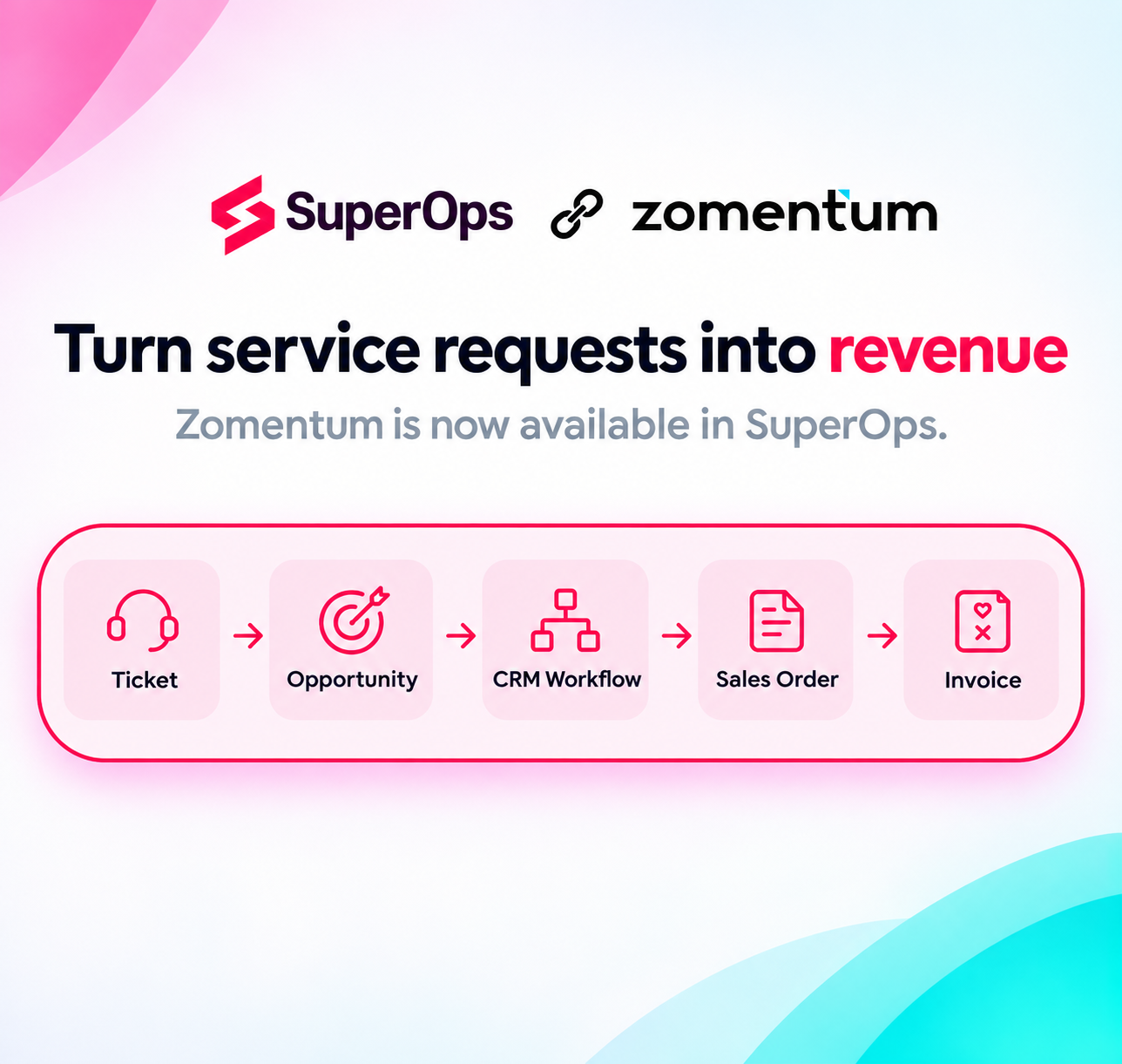
Zomentum is now available in SuperOps, giving MSPs a connected workflow within SuperOps that takes them from a customer request to an invoice. Instead of moving information between a sales tool and a delivery tool, MSPs can manage the whole path in one place.
The Sales-to-Service Handoff Is Where MSPs Lose Time
The handoff between sales and service is one of the most important moments in an MSP’s customer lifecycle. During the sales process, the MSP learns about the customer’s business, technology environment, challenges and expectations. By the time the customer signs, a great deal of context has built up around the relationship, and the customer expects it to carry forward. They do not expect to explain the same requirements again because they have moved from the sales conversation to the service team.
When sales and service live in separate systems, keeping that continuity takes manual effort, and it shows up in three ways:
- Duplicate entry: the same customer and deal details are typed into more than one system.
- Tool-switching: finding out where a deal or request stands means opening several tools.
- Handoff gaps: context is passed between teams by email, spreadsheet or memory, and some of it is lost.
None of this is a problem with a handful of customers. As an MSP grows, more deals mean more quotes, more signed agreements mean more handoffs, and the people who feel it first are the account managers and service teams doing the re-entry.
One Connected Workflow: Ticket to Invoice
With Zomentum available in SuperOps, MSPs can connect sales and delivery in a single workflow:
Ticket → Opportunity → CRM Capabilities → Sales Order → Invoice
Here is what each step means in practice:
- Ticket: a customer request starts as a ticket in SuperOps, the same place the service team already works. Requests such as a hardware refresh, a new service or additional users often begin this way.
- Opportunity: when a request involves new business, it can be turned into an opportunity, so the sales work is tied to the original request rather than starting from a blank record.
- CRM Capabilities: Zomentum’s CRM and quoting capabilities, available within SuperOps, are used to manage the opportunity and build the quote. Sales activity is tracked alongside the customer and service information that already lives in SuperOps.
- Sales Order: once the customer accepts, the deal becomes a sales order, which records what was sold.
- Invoice: the sales order leads to an invoice, so billing reflects what was agreed.
The result is a path from the first request to billing that stays in one connected environment. Sales and delivery do not have to be reconciled afterwards because they were never separated.
What a Connected Workflow Means for MSP Teams
The benefit is not just convenience. It changes how different parts of the business work day to day.
For sales and account managers, opportunities start with the context that already exists. A ticket shows what the customer asked for, so the quote is built on the actual request, with no need to chase the service team for background.
For service and delivery teams, what was sold is visible without asking. When a deal closes, the team that will deliver it can see the customer record, the request that started it and the commercial terms.
For finance and operations, the sales order and invoice come from the same workflow as the opportunity, so what was agreed with the customer and what is billed can be traced back to the same record.
For all three, customer information is captured once, deals move to delivery without being rebuilt, and everyone can see where a request or deal stands.
Example: From a Customer Ticket to an Invoice
Consider an MSP supporting a 40-person professional services firm. One morning, the firm’s office manager contacts the MSP to say that a number of staff laptops have become old and slow. The request is logged as a ticket in SuperOps.
The service desk reviews the ticket and sees that it is more than a support issue. The firm needs replacement hardware, which is new business. The account manager turns the ticket into an opportunity, so the original request and the customer’s history stay attached to it.
Using Zomentum’s CRM and quoting capabilities within SuperOps, the account manager builds a quote for the replacement laptops and shares it with the customer. Because the quote is built from the same customer record, there is no need to re-enter company details or look up what the customer already has.
The customer reviews the quote and accepts. The deal becomes a sales order, and the sales order leads to an invoice. From the first ticket to the final invoice, the customer’s information was entered once, and the account manager and service desk could both see the full picture.
Why Reducing Tool-Switching Matters as MSPs Grow
As an MSP adds customers, the number of handoffs grows with it. Each time a person copies information from one tool to another, there is a chance of error and a delay before the next step can start. Over time, teams become the connection between their own software, and that does not scale.
Fewer fragmented workflows means staff spend less time on re-entry and status checks, there are fewer mistakes in orders and invoices, and new team members have fewer tools to learn before they are productive. Customers do not see an MSP’s internal systems. They see one company, and the more connected the workflow behind it, the more consistent their experience is from the first conversation to the final invoice.
What to Look for in a Connected Sales and Service Workflow
Whether an MSP is evaluating this integration or reviewing its current process, a few questions show how connected the workflow really is:
- Is customer information entered once? If the same details are typed into two systems, the workflow is still split.
- Does a deal keep its origin? An opportunity should be traceable back to the request that started it, and the invoice back to the opportunity.
- Can the service team see what was sold? Delivery should not depend on a handoff email.
- How many tools does a deal pass through? Each extra tool is another place to re-enter data and lose context.
Getting Started with Zomentum in SuperOps
Zomentum is provisioned through SuperOps. Existing Zomentum accounts can’t currently be connected to SuperOps.
To learn more about Zomentum in SuperOps, visit the SuperOps page: https://superops.com/signup
For an MSP, closing the deal is not the end of the sales journey. It is the beginning of the customer relationship.