You've closed the deal. The proposal is signed, the upfront deposit collected, the managed services contract is live, and your client is onboarded inside Zomentum. Recurring invoices are firing on schedule. Your automated dunning sequences are handling any late payments before they become a collections problem. By every measure, you're set up for clean, efficient billing.
Then a client calls. They need to accommodate two more servers in the current deal. Or your hardware installation job ran into more hours than initially scoped. Or a prospect has verbally committed and wants to put down a deposit before they've signed anything.
Suddenly, your billing infrastructure as complete as it is has no natural entry point for this charge. It isn't a proposal. It isn't a recurring invoice. It doesn't belong in a dunning sequence. It's a one-off, time-sensitive payment that needs to move right now.
So you open Stripe. Or you raise a manual invoice in QuickBooks. Or you send a bank transfer request and wait. In each case, that payment lands outside of Zomentum, creating a split in your revenue reporting, a reconciliation headache, and a moment where your payment infrastructure fragments exactly when you need it to hold together.
This is the revenue gap Zomentum Payment Links is built to close.
Why Your Existing Workflows Are Already Strong And Where They Stop
It's worth being precise about what Zomentum already handles well, because the case for payment links only makes sense once you understand what it's complementing, not replacing.
Zomentum's proposal-anchored checkout is genuinely excellent at what it does. A client opens a proposal, reviews the scope, signs, and pays the initial deposit all in a single guided session. Deal-closing, upfront collection, and contract execution happen in one flow. For that moment, nothing in the MSP space matches it.
After the deal closes, Zomentum's recurring billing engine takes over. Scheduled invoices, automated payment collection, and dunning sequences that follow up on lapsed payments without your team lifting a finger. For the predictable, repeating revenue that forms the backbone of any managed services business, this is the right infrastructure.
But both of those workflows share a structural boundary. They're anchored to formal billing objects. A proposal. A recurring invoice. A dunning sequence tied to that invoice.
The moment you need to collect money that exists outside those objects, mid-engagement, after signature, for a one-off charge, or before a proposal has even been created neither workflow has a native entry point.
That's not a design flaw. It's simply the defined boundary of what each tool was built to do. Payment Links exist specifically for everything that falls outside that boundary.
The 6 Revenue Moments Your Current Workflow Is Missing
Hardware and One-off Purchases
You quote a server refresh. The managed services contract is already live; there's no new proposal to run. The order comes in verbally or over email.
You either raise a manual invoice (slow, disconnected from your reporting) or fire up Stripe separately (fast, but fragmented another payment source to reconcile at month-end). Neither is clean.
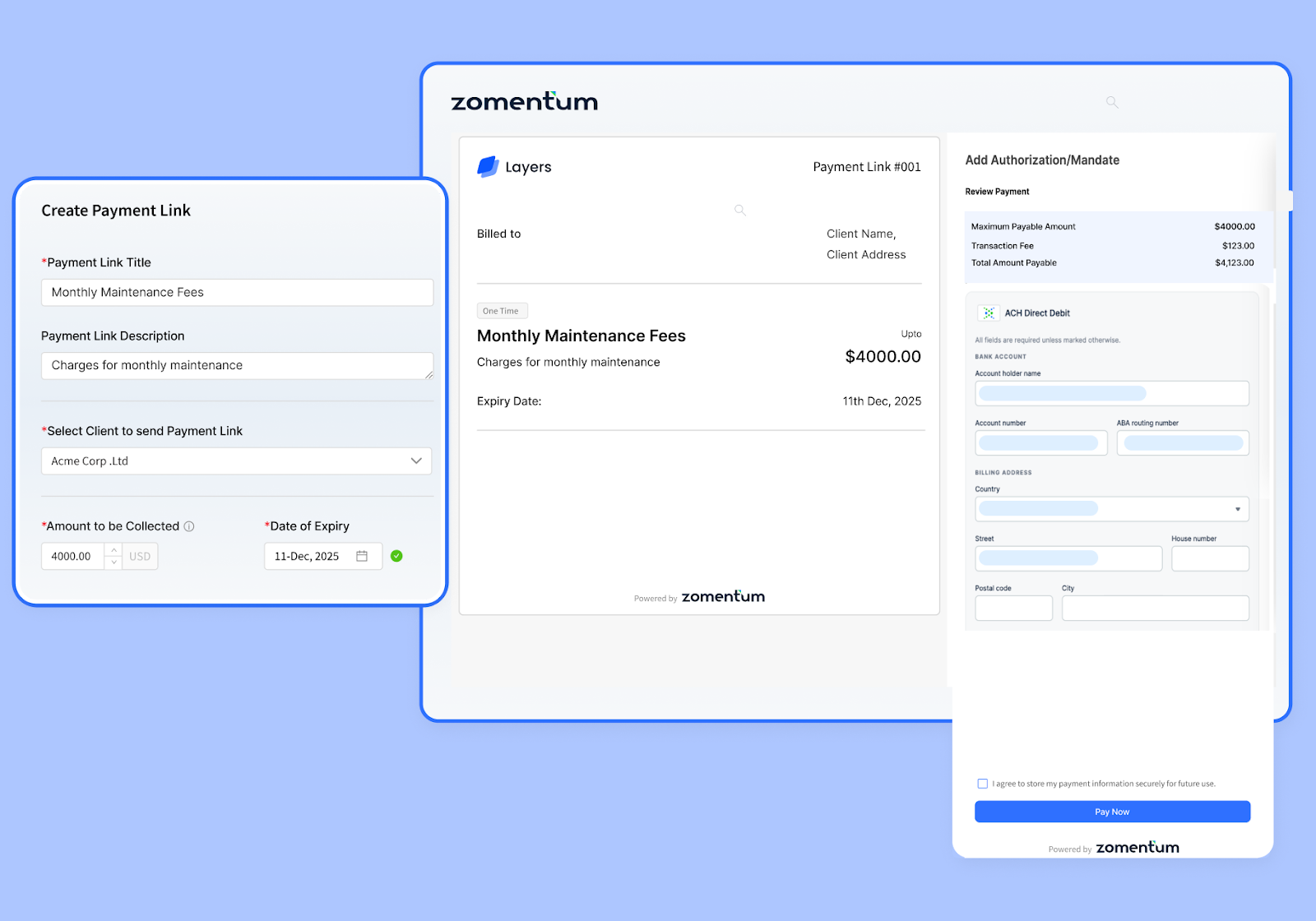
With a Zomentum Payment Link, you generate a specific-amount URL from inside the platform you're already on, send it in under 30 seconds, and the payment reconciles directly into your Zomentum ledger. No context switching. No split reporting. One platform, one source of truth.
Project Milestone Invoicing Mid-Engagement
If you do project work network migrations, infrastructure builds, security implementations you're likely collecting at defined milestones: 50% at kickoff, 50% at delivery, or structured payments tied to specific completion phases.
The problem: the original proposal was signed months ago. There's no proposal session open and no formal billing trigger until the milestone is reached. Raising a whole new proposal for a progress payment is ceremonially wrong; it signals to the client that something new is being contracted, not that work already underway is being billed.
Payment Links solve this cleanly. A pre-set amount with a milestone description "Network Migration: Phase 1 Completion" sent as a URL. The client pays from wherever they are. The payment flows back into Zomentum without a manual reconciliation step.
Onboarding and Setup Fees Before the First Recurring Invoice
Your recurring billing engine has a start date. Your onboarding team starts work on day one.
For most MSPs, that creates a gap. The setup fee for network documentation, tool deployment, initial configuration needs to be collected immediately after the proposal is signed, as a separate transaction, before the first MRR invoice fires. While Zomentum supports initial payment collection alongside deal signatures in one flow, your previously won deals and any opportunities not yet collected on, may still have an outstanding setup fee waiting.
Bundling it into the first recurring invoice looks awkward to the client and risks the onboarding cost getting absorbed silently if the invoice triggers any dispute. Forgetting it entirely is obviously worse.
A Payment Link for the setup fee closes this gap at the right moment: post-signature, pre-billing cycle, with the amount pre-set and the description clear.
Ad-Hoc Charges Outside the Recurring Invoice Cycle
Zomentum's automated dunning handles lapsed recurring payments effectively. That's a solved problem. But there's a different category of overdue charge that dunning wasn't designed for. One-off amounts that were never part of a recurring invoice to begin with.
A hardware order invoiced manually. An out-of-scope labour charge raised in QuickBooks. A verbal agreement for additional licenses that never made it into a formal billing object. These charges sit outside Zomentum's dunning infrastructure entirely, which means when they go unpaid, there's no automated recovery path.
A Payment Link for the outstanding amount, sent via email or WhatsApp with the charge pre-filled is a proven B2B collections mechanic for exactly this scenario. It's frictionless for the client, requires no portal login, and because it resolves inside Zomentum Payments, reconciliation is automatic. No manual matching. No revenue sitting in a Stripe account disconnected from your Zomentum dashboard.
Ad-Hoc Upsells and Verbal Add-ons
A client calls. They need 10 additional Microsoft 365 licenses by the end of day. You agree. There's no time and no need for a formal proposal.
Without a Payment Link, this upsell either gets added to next month's invoice (delayed revenue, easy to forget), chased manually (awkward, slow), or simply falls through the cracks. None of those outcomes is acceptable for an MSP trying to run a tight P&L.
A Payment Link for the prorated amount can be generated and texted to the client's phone in minutes. The revenue is collected the same day. The transaction is reconciled in Zomentum. The relationship feels smooth rather than cumbersome.
Pre-Sale Deposits from Prospects
A prospect has verbally committed but hasn't formally signed yet. You want to collect a deposit to confirm intent and secure the engagement.
The challenge: They haven't signed a contract yet. Running them through the full proposal flow just to collect a deposit is heavy-handed for a relationship still in the trust-building phase.
A Zomentum Payment Link solves this without requiring the prospect to have a client portal login or navigate the full proposal experience. It collects the deposit, signals intent, and routes the payment into your Zomentum revenue reporting so when they do sign, the deposit is already reconciled in the same system as their ongoing billing.
Why This Matters More If You're Already on Zomentum Payments
For an MSP using Zomentum Payments across proposals, recurring billing, and dunning, the case for Payment Links isn't "here's a new feature." It's a consolidation argument.
You already have:
- A merchant account inside Zomentum
- Reconciliation flowing into your QuickBooks or Xero integration
- Payment reporting inside the Zomentum dashboard
Right now, every one of the six scenarios above forces you outside that infrastructure. You're using Stripe, QuickBooks Payments, or manual bank transfer each creating a separate reconciliation stream and a second source of truth for revenue that never cleanly aligns with what Zomentum shows.
Payment Links close that gap. The argument is straightforward: you already use Zomentum Payments for proposals, recurring billing, and overdue recovery. Payment Links mean you never need to touch Stripe for anything else.
This is the same expansion strategy that allowed Stripe to move from developer tooling to full financial infrastructure widening the surface area of use cases until every payment, regardless of context, resolves through one platform. For an MSP, that platform should be the one that already understands your proposals, your client relationships, your contracts, and your MSP-specific revenue reporting.
Stripe Payment Links are powerful. But they have no context about your clients, your margins, or your contract terms. Zomentum's do. Same friction to send. Zero extra reconciliation on the other end.
The Broader Pattern: Businesses That Need This Most
Zomentum Payment Links solve a specific structural problem: revenue that's lumpy, irregular, or partially outside a recurring billing engine, where the payment moment is time-sensitive enough that a frictionless URL is the only mechanism that doesn't result in a delayed or missed collection.
This pattern appears across every professional services vertical:
What connects all of these? The payment event doesn't wait for a formal billing cycle. It happens at a specific moment a milestone is reached, a conversation completed, a client's immediate need met and the only instrument that captures it without delay is a link that anyone can pay from any device, without logging into anything.
For MSPs, that moment arrives constantly. The question is whether your payment infrastructure is built to capture it.
Closing the Gap
Zomentum Payment Links isn't a utility feature added to fill out a product roadmap. It's the last mile of revenue collection that proposal checkout, recurring billing, and automated dunning were never designed to reach, not because those tools fall short, but because they were each built for a different, well-defined job.
For an MSP already on Zomentum Payments, it's the difference between Zomentum being most of your payment infrastructure and Zomentum being all of it.
Every missed hardware payment, every delayed project milestone collection, every ad-hoc charge that got lost between a verbal agreement and month-end invoicing those aren't operational inconveniences. They're revenue sitting in transit between your client's intent to pay and your ability to capture it cleanly. Payment Links exist to close that distance.
Ready to stop splitting your payment workflow between platforms?
.png)
.png)