
If you’re an MSP evaluating payment solutions, Stripe probably came up early in your research. It’s the default recommendation in most “best payment tools” lists and for good reason. Stripe is powerful, flexible and trusted by millions of businesses worldwide.
But “powerful and flexible” comes with a catch: Stripe was built for developers and digital-first businesses, not for managed service providers who need to collect recurring revenue, managed client payment mandates, chase down failed payments, and reconcile it all against a PSA without writing a single line of code or hiring a developer to configure it.
That’s the gap Zometum Payments is built to close.
This post breaks down exactly how Zomentum Payments and Stripe compare across the dimensions that matter most of MSP billing: automation, integrations, pricing transparency and payout speed. No hype, just a clear-eyed look at what each platform does, where it excels, and where it falls short of the MSP use case.
Why MSP Billing Is a Different Beast
Most payment platforms are designed for transactional, one-time purchases. MSP billing isn’t that. You’re managing:
- Monthly recurring contracts with variable line items
- Hardware and project invoices on top of MRR
- Clients who forget to update payment methods
- Finance team who needs everything reconciled against QuickBooks or Xero
- Distributor costs that need to be factored into margins
The result is a billing workflow that spans quoting, invoicing, collections reconciliation and cash flow management all of which need to talk to each other. A generic payment gateway handles one piece. A purpose-built MSP payments platform handles the whole chain.
Zomentum Payments vs. Stripe: Feature-by-Feature Comparison
Payment Collection & Automation
Both platforms support instant payment links, saved payment methods, and automated invoice collection. The table stakes of any modern billing tool. Where they diverge is in how much configuration that automation requires.
Zomentum Payments includes auto collection logic that can be triggered based on custom fields and scheduled delays without developer involvement. You set the rules inside the platform, and collections run automatically.
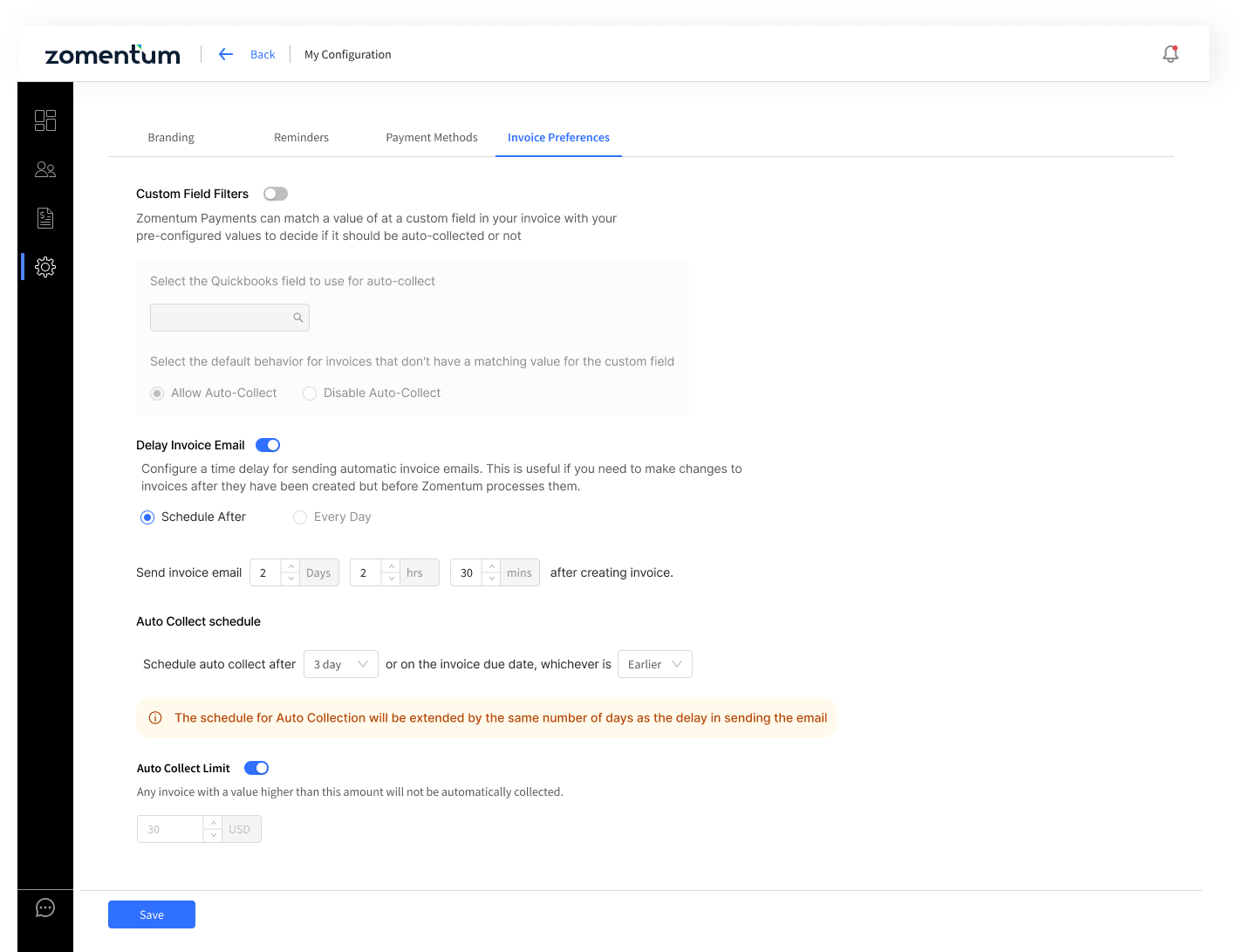
Stripe’s billing automation offers similar outcomes, but custom field-based triggers require developer configuration. For MSPs without in-house dev resources, that is a meaningful barrier.
Dunning, the process of automatically retrying failed payments and sending reminder sequences, is supported by both platforms. Stripe’s Smart Retires and configurable dunning emails (up to four) are well-regarded. Zomentum Payments also includes automated dunning, designed specifically around the way MSPs communicate with clients.
VERDICT: Feature parity on the basic; Zomentum wins on no-code configurability for MSP-specific automation.
Client Portal & Self-Service
Both platforms offer a self-serve client portal where clients can view invoices, make payments, and manage their payment methods. This reduces the back-and-forth that finance teams deal with on a daily basis.
Stripe’s customer portal is hosted and polished. Zometum’s client portal is built for the MSP client relationship, inside a platform your clients are already interacting with across your broader service delivery workflow.
VERDICT: Tier on core functionality.
Accounting & PSA Integrations
Both Zometum Payments and Stripe integrate with QuickBooks Online (US and UK) and Xero. Stripe’s integrations run via its billing product layer.
The difference: Zomentum Payments sits inside the same platforms where your quotes, proposal and client records live. When a payment is collected, it flows back into Zomentum’s quote-to-cash workflow before syncing to your accounting system, with no manual reconciliation step in between.
Stripe, as a standalone payment layer, requires additional work (or middleware) to connect collected payments back to your CRM, Quoting tool and accounting system.
VERDICT: Zometum wins for MSPs who want end-to-end quotes to cash in one platform.
Currency & Geographic Support
Both platforms support USD and GBP, covering the two primary MSP markets in the US and UK.
One notable gap in Stripe’s UK offering: BACS Direct Debit is not supported. Stripe is not a direct debit provider, so UK MSPs who want to collect payments via bank debit need a workaround or a separate provider. Zomentum Payments supports BACS at 1% + £0.20 (capped at £4), making it a complete solution for UK-based MSPs without additional tooling.
VERDICT: Zomentum wins for UK MSPs who need BACS support.
Payout Speed
This one matters more than it often gets credit for. Cash flow is a real operational concern for MSPS managing large hardware purchases, staffing costs and distributor invoices.
Zomentum Payments offer T+1 payout on sales day (next working day). Stripe’s standard payout is T+2 in the US and T+3 in the UK. Stripe does offer instant payouts with an additional 1% fee.
For MSPs running tight margins, getting paid a day or two earlier isn’t just a nice-to-have. It’s working capital.
VERDICT: Zomentum wins on payout speed and without and without an additional fee.
Pricing Transparency
Both platforms charge 2.9% + $0.30 for US card transactions and comparable rates in the UK. ACH rates are also similar: 0.8% capped at $5 (note: Zomentum’s ACH fee is free on Expand/Growth Plans)
Where the real difference shows up is in what you don’t see in the headline rate.
Stripe adds fees that aren’t obvious upfront:
- £20 per chargeback
- 1% fee for instant payouts
- 2% FX conversion fee
- 1% cross-border transaction fee
Zomentum Payments has none of these. NO surcharge, NO VAT on fees, NO processing fee, NO high-value transaction fee.
Zomentum Payments does have a $39/month platform fee for the standalone payments product, though this is waived on bundled Zomentum Plans. Stripe has no monthly fee, operating on a pure pay-per transaction model.
For MSPs processing significant volume, the math often favors Zomentum’s predictable flat rate over Stripe’s accumulating per-transaction add-ons.
VERDICT: Zometum wins on total cost predictability; Stripe’s model works better for very low-volume billing.
The Core Question: Payment Gateway Or MSP Billing Platform?
Stripe is a world-class payment infrastructure company. If you need maximum flexibility, global currency support and have developer resources to configure it for your exact workflow, it can be made to work for MSP billing. But “made to work” is doing a lot of heavy lifting in that sentence.
Zomentum Payments is built for one thing: helping MSPs collect revenue faster, with less manual effort, inside the same platform where they quote and close business. It doesn’t require configuration work to unlock the automations that matter most to your billing team. The features MSPs need are dunning, mandate management, accounting sync, BACS support, T+1 payouts are available out of the box.
If you’re running a growing MSP and you want a payments solution that fits your workflows without a developer on speed dial, Zomentum Payments is worth a close look.
Ready to See It In Action
Zomentum Payments is built into the Zomentum platform alongside quoting, proposals and client management so your entire quote-to-cash workflow lives in one place.
Request a demo to see how Zomentum Payments can streamline billing for your MSP.
Note: Partial payments on invoices are currently on the Zomentum Payments roadmap and coming soon.
.png)
.png)